Ramayana Summer Camp – A Journey from Dharma to Leadership
Three Days. One Epic. A Lifetime of Learning.
The Ramayana is far more than an ancient story. It is a living guide to character, courage, leadership, relationships, responsibility, and the choices we make in everyday life. Over three days, our young participants explored the Ramayana through stories, discussions, Sanatana Dharma, temple traditions, Yoga, Bhagavad Gita, Bhajans, and even the possibilities of Artificial Intelligence.
The goal was simple: to help our children discover how timeless wisdom can become relevant to modern life.
🌿 Day 1 — Discovering Rama, Dharma & Our Heritage
Module 1: The Ramayana — An Epic for Life
The journey began with the story of the Valmiki Ramayana, one of the great epics of Sanatana Dharma.
The students learned that the Ramayana consists of approximately 24,000 shlokas across seven kandas and, more importantly, is a guide to Dharma, leadership, family values, and social responsibility.
The opening conversation between Valmiki Maharishi and Devarshi Narada introduced the central question: What does an ideal human being look like?
Narada described Rama as the embodiment of noble qualities such as truthfulness, courage, compassion, gratitude, self-control, wisdom, and unwavering commitment to Dharma.
Module 2: Rama’s Childhood — Character Before Leadership
Through stories from Bala Kanda, students explored how Rama’s character was shaped through education, discipline, service, courage, and responsibility.
The discussion went beyond familiar stories. Students discovered lessons about: Ethical leadership, Good governance, Responsible citizenship, Lifelong learning, Discipline and balanced living, Service to society, Protecting others from harm.
The description of Ayodhya provided an opportunity to explore ideas of city planning, civic administration, competent ministers, and the qualities of an ideal ruler.
Module 3: Legacy — What Will We Leave Behind?
The story of Dasharatha’s Putrakameshti Yajna introduced the concept of Sapta Santanam — the idea that our legacy can live beyond us through noble works that benefit future generations. The children explored examples such as providing drinking water, protecting forests and animals, supporting education, and undertaking charitable works.
The message was powerful: A meaningful life is not only about what we achieve for ourselves, but what we leave behind for others.
Module 4: Sanatana Dharma — A Way of Life
The afternoon moved from the Ramayana to the broader philosophy of Sanatana Dharma.
Students explored its scriptures, traditions, philosophical ideas, and its emphasis on ethics, morals, principles, character, and living responsibly. The session also explored India’s contributions to mathematics, astronomy, medicine, metallurgy, and other areas of knowledge.
The day concluded with Bhajan singing, giving students an opportunity to experience devotion not merely as something to study, but something to feel, participate in, and celebrate together.
🪔 Day 2 — Understanding Our Traditions & Connecting Them to the Future
Day 2 expanded the journey from “What does our tradition teach us?” to “Why do we practice what we practice?” The day brought together Ramayana stories, Hindu temple traditions, AI, and the Bhagavad Gita.
Module 1: The Science & Meaning Behind Temple Traditions
Students explored familiar temple practices and were encouraged to look beyond simply following rituals.
Naivedyam — The Meaning Behind an Offering: Using Bhagavad Gita 9.26, the discussion emphasized that an offering is meaningful because of the love and devotion behind it, rather than merely its material value.
Super Brain Yoga Students were introduced to Super Brain Yoga, its traditional origins, the associated Puranic stories, the practice itself, and research discussed during the session.
The session turned an ancient practice into an interactive experience — allowing children to learn by doing, not simply listening.
Understanding Pradakshina Why do we walk clockwise around a deity? The students explored the symbolism of placing the Divine at the center of our existence, with our thoughts and actions revolving around that center.
A simple temple practice became a lesson in a much larger idea:
What is at the center of my life?
🤖 Module 2: AI — From Technology Consumer to Technology Creator
One of the most modern sessions of the camp introduced students to Artificial Intelligence. Rather than treating AI as something mysterious or distant, the session demonstrated how young people can use AI as a creative and entrepreneurial partner.
Students experienced live demonstrations including: A voice-controlled AI assistant, Autonomous AI agents, AI-generated long-form content, Generative images, Generative video, Visual storytelling
The students also explored practical applications such as creating flyers for community events, helping with family businesses, and developing content for non-profits.
The AI Challenge Learning turned into action. Students were challenged to create an original AI video using Google Flow, summarizing what they had learned from the Ramayana or Bhagavad Gita sessions.
The camp therefore connected two seemingly different worlds: Ancient wisdom + modern technology.
📖 Module 3: Bhagavad Gita
The Bhagavad Gita session complemented the Ramayana discussions by bringing the focus back to Dharma, choices, responsibility, and living with purpose. Together, the Ramayana and Gita helped students see that Dharma is not simply a subject from the past. It can guide decisions in school, friendships, family, leadership, technology, and everyday life.
🕉️ Day 3 — From Tradition to Courage, Confidence & Practice
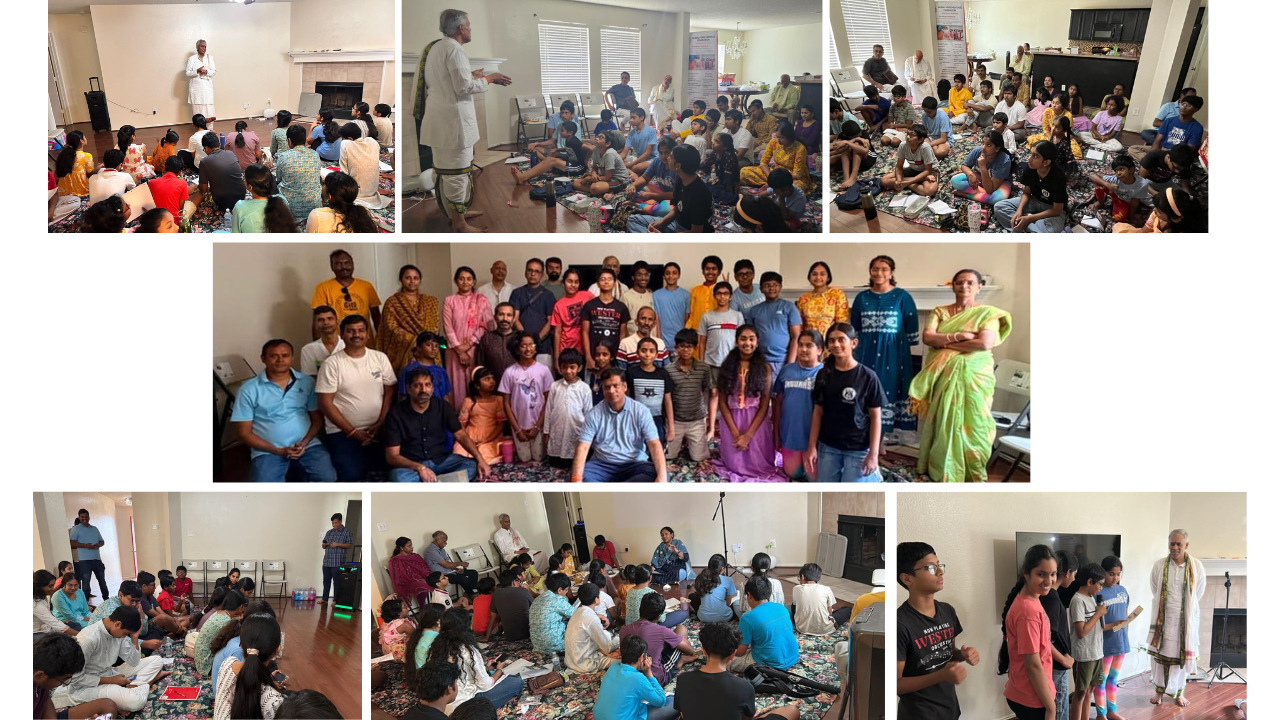
The final day brought together the lessons from the previous two days and focused strongly on courage, confidence, resilience, spiritual understanding, and practice. Approximately 30 youth and 10 parents participated in the Sunday session.
Module 1: Lessons from Rama — Courage in Difficult Times
Through incidents from the Ramayana, students explored how the characters faced adversity and what those experiences can teach us today.
The emphasis was on developing: Fearlessness • Courage • Confidence • Strength • Resilience. The central idea was that understanding the Ramayana can help young people develop the inner strength needed to face stressful and difficult situations.
🛕 Module 2: Sanatana Dharma Murti Worship — Seeing Beyond the Form
The students explored an important question: Why do Hindus worship a Murti?
The session explained Murti, Vigraha, and Pratima as forms through which devotees can focus their attention and connect with the Divine. The famous Swami Vivekananda and Maharaja of Alwar story provided a simple analogy: just as a photograph can remind us of and invoke feelings toward a person, a Murti can serve as a tangible focus for devotion.
One Divine Reality, Many Forms
The discussion then explored another question children naturally ask: “Why are there so many Gods?”
Students were introduced to the idea that the many manifestations of Hindu deities can be understood as different expressions or aspects of the one underlying Divine reality — like the many rays that ultimately come from one Sun.
🧘 Module 3: Yoga — Learning Through the Body
The final day also brought Yoga into the learning experience.
Students were introduced to Yoga postures and practiced them together. The session also connected Yoga and mindful living with healthy eating habits.
This reinforced an important message of the camp:
Sanatana Dharma is not only something we read. It is something we practice.
🎯 The Journey Continues — Ramayana for Modern Life
The camp concluded with an essay competition inviting students to reflect on:
“Ramayana for Modern Day Life — My Learnings from the Camp”
The objective was to move the children from learning → reflection → application. Because the real measure of the camp is not how much a child can remember about Rama. It is how much of Rama’s values the child can carry into everyday life.
❤️ The Message We Hope Every Child Takes Home
The Ramayana is not just a story about something that happened thousands of years ago.
It asks questions that remain relevant today:
How do I make the right choice when it is difficult?
How do I treat my parents, friends and community?
How do I respond when life doesn’t go my way?
What does true leadership look like?
How can I use technology responsibly?
What values will define my life?
And ultimately — what kind of person do I want to become?
That is the spirit of the Ramayana Summer Camp.
Ancient wisdom. Young minds. Modern tools. Timeless values.
And the journey doesn’t end when the camp ends.
It begins when the learning becomes a way of life.
0 Comments